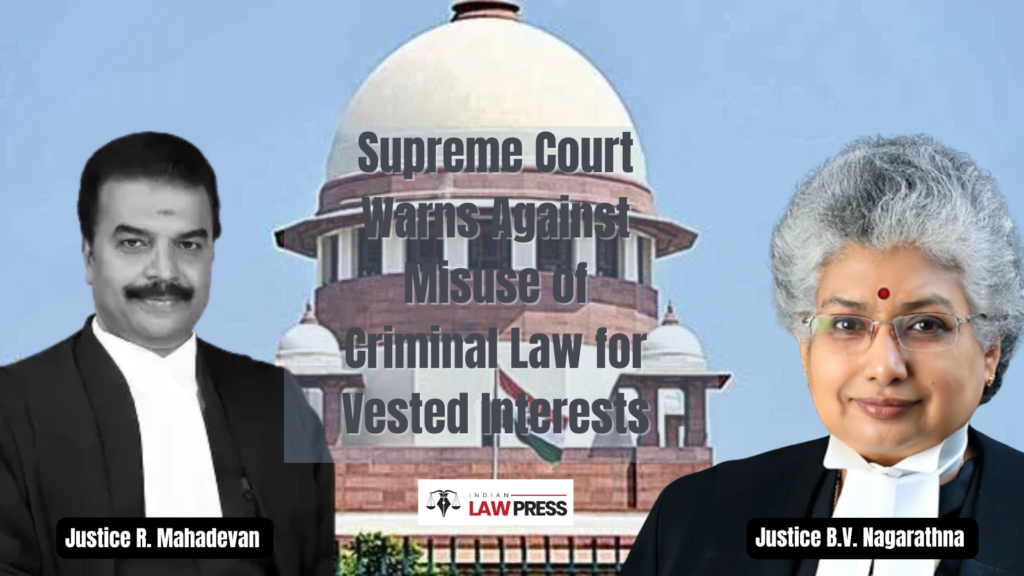

The Supreme Court has reiterated that criminal law must not be used to settle civil disputes or pursue vested interests. In Inder Chand Bagri v. Jagadish Prasad Bagri (2025), the Court quashed IPC charges for lack of criminal intent.
Introduction
The Supreme Court of India has once again emphasised that criminal law cannot be misused to settle civil disputes or pursue personal interests.
In the case of Inder Chand Bagri v. Jagadish Prasad Bagri & Another (2025), the Court quashed criminal proceedings under Sections 406, 420, and 120B of the IPC, citing absence of essential ingredients required to sustain such charges.
The judgment highlights the judiciary’s responsibility to prevent misuse of criminal proceedings and protect individuals from unnecessary harassment.
Background of the Case
The dispute originated from a partnership formed in 1976 for construction and leasing of godowns. A supplementary agreement was executed in 1981, and the partnership was eventually dissolved in 1997 following a civil suit.
In 2011, the appellant executed a sale deed in favour of a third party. The complainant challenged this through a civil suit in 2012 and later filed a criminal complaint in 2013, alleging cheating, criminal breach of trust, and conspiracy.
While the trial court took cognisance of the offences, and the Gauhati High Court granted partial relief to one accused, the appellant approached the Supreme Court seeking quashing of proceedings.
Supreme Court’s Key Observations
No Evidence of Cheating (Section 420 IPC)
- Cheating requires dishonest intent at the beginning of the transaction
- No such intention was alleged at the time of forming the partnership
- Subsequent actions cannot automatically imply fraudulent intent
No Criminal Breach of Trust (Section 406 IPC)
- No proof of entrustment of property
- No evidence of dishonest misappropriation
- Property ownership and agreements supported the appellant’s position
Mutually Contradictory Allegations
- Cheating and breach of trust claims were inconsistent
- Both cannot be invoked simultaneously on conflicting facts
- The Court found the allegations legally unsustainable
Civil Dispute Given Criminal Colour
- The matter was already being pursued through civil remedies
- Criminal proceedings were initiated to exert pressure
- The Court relied on principles from State of Haryana v. Bhajan Lal
Warning Against Misuse of Criminal Law
- Criminal law should not be used for personal or commercial disputes
- Misuse burdens the judicial system and affects fairness
- The Court reiterated concerns from Vishal Noble Singh v. State of Uttar Pradesh
Judgment and Final Outcome
The Supreme Court held that:
- No prima facie case under Sections 406 or 420 IPC was established
- Essential ingredients of the offences were missing
- Continuation of proceedings would amount to harassment
Accordingly, the Court allowed the appeal, set aside the Gauhati High Court order, and quashed the criminal complaint along with all related proceedings.
Appearances
- Petitioner: Pooja Dhar, AOR
- Respondents: Somiran Sharma, AOR with Advocate Snigdha Shresth
Key Highlights
- Criminal law cannot be used for civil disputes
- Absence of intent weakens criminal charges
- Courts must prevent misuse of legal process
- Reinforces principles from Bhajan Lal case
- Protects individuals from malicious prosecution
Conclusion
The ruling by the Supreme Court of India serves as a strong reminder that criminal proceedings must not be misused as a tool for harassment or to settle civil disputes.
The judgment reinforces the need for courts to carefully examine allegations and ensure that criminal law is invoked only when genuine criminal intent is evident.
Such decisions play a crucial role in maintaining the integrity of the justice system and protecting individuals from unnecessary legal burdens.
Also Read
Supreme Court: Living Separately Cannot Be Treated as Irretrievable Breakdown of Marriage