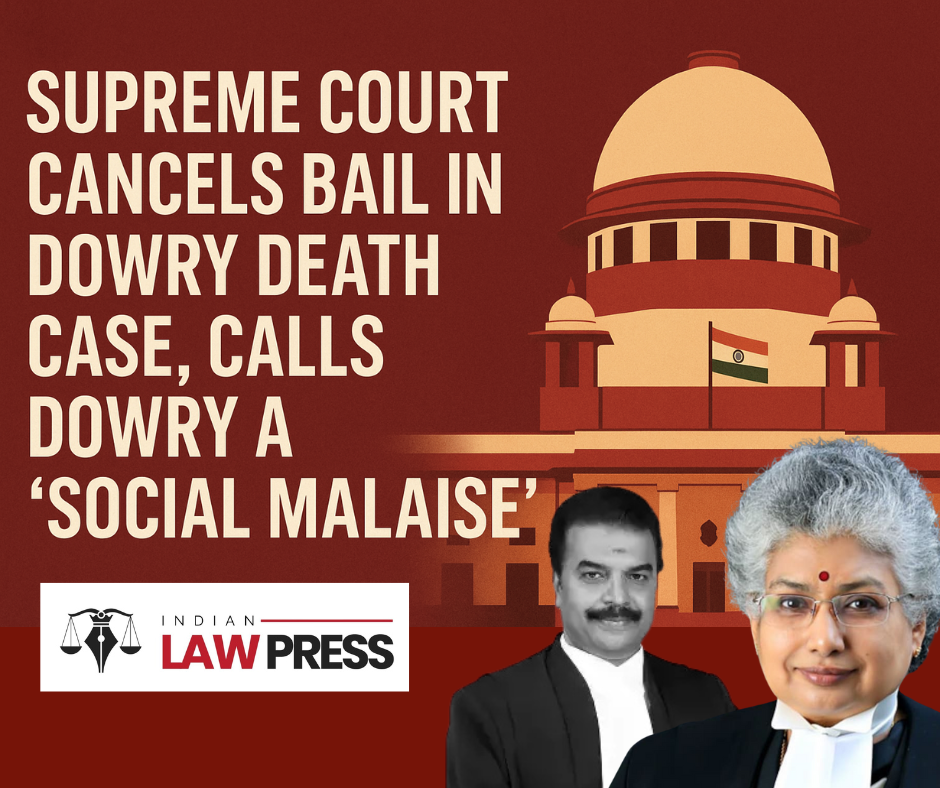

The Supreme Court cancels bail in a dowry death case, condemning the persistence of dowry practices and emphasising the need for judicial vigilance in serious offences.
In a significant ruling delivered on November 28, the Supreme Court cancelled the bail of a man accused of poisoning his wife for dowry merely four months after their marriage. The Court used the occasion to make a strong statement against the continuing practice of dowry, observing that it has reduced the sacred institution of marriage into a commercial transaction driven by social status and material greed.
A Bench of Justices BV Nagarathna and R. Mahadevan set aside the Allahabad High Court’s order granting bail to the accused husband, terming it “perverse and unsustainable.” The order came in an appeal filed by the deceased woman’s father.
Dowry: A Continuing Threat to Human Dignity
The Supreme Court lamented that marriages, traditionally based on mutual trust, companionship, and respect, are increasingly tainted by the expectation of dowry. The Bench remarked that although often disguised as gifts, dowry demands have become a means to flaunt social standing and fulfil material cravings.
The Court strongly condemned dowry deaths, calling them among the “most abhorrent manifestations” of this social evil. It noted that such crimes violate core constitutional values, including the right to equality (Article 14) and the right to life with dignity (Article 21). Beyond the individual tragedy, dowry deaths corrode social morality, normalize violence against women, and undermine the foundations of a civilised society.
Case Background: Death Within Months of Marriage
According to the prosecution, the victim married Respondent No. 1 on February 22, 2023. Soon after, she was allegedly subjected to harassment for additional dowry—specifically, a Fortuner car.
The young woman died on June 5, 2023, after reportedly consuming poison under suspicious circumstances. Moments before her death, she made a distress call to her elder sister around 1:30 AM, alleging that her husband and his relatives had “forcibly administered some foul-smelling substance” to her.
A Forensic Science Laboratory (FSL) report later confirmed the presence of aluminium phosphide, a deadly poison.
Supreme Court’s Critique of the High Court Bail Order
The Supreme Court held that the High Court had failed to consider:
- the gravity of the offence,
- the corroborated dying declarations,
- the post-mortem findings, and
- the statutory presumption applicable in dowry death cases.
Justice Mahadevan, authoring the judgment, observed that granting bail to individuals allegedly involved in such serious crimes risks compromising the fairness of the trial and erodes public confidence in the criminal justice system.
The Court reiterated that bail orders lacking proper judicial scrutiny—especially in heinous offences—can be cancelled. Courts must evaluate all relevant factors, including the seriousness of the allegations, the strength of the evidence, and the possibility of misuse of liberty.
Given these lapses, the Supreme Court allowed the appeal and cancelled the accused’s bail.
Conclusion
This judgment—Yogendra Pal Singh vs. Raghvendra Singh @ Prince & Another—serves as a vital reminder of the judiciary’s responsibility in cases involving violence against women. By taking a firm stance, the Supreme Court reinforced the need to treat dowry death cases with utmost seriousness and highlighted the urgency of combating the deep-rooted social evil of dowry.
Don’t Let Ego Ruin Marriage’: Supreme Court’s Strong Message to Wife in Marital Case