
India will implement the four Labour Codes on 21 November 2025, replacing 29 labour laws. Learn key provisions, reforms, worker rights, and compliance changes.
India to Implement Four Labour Codes from November 21, 2025
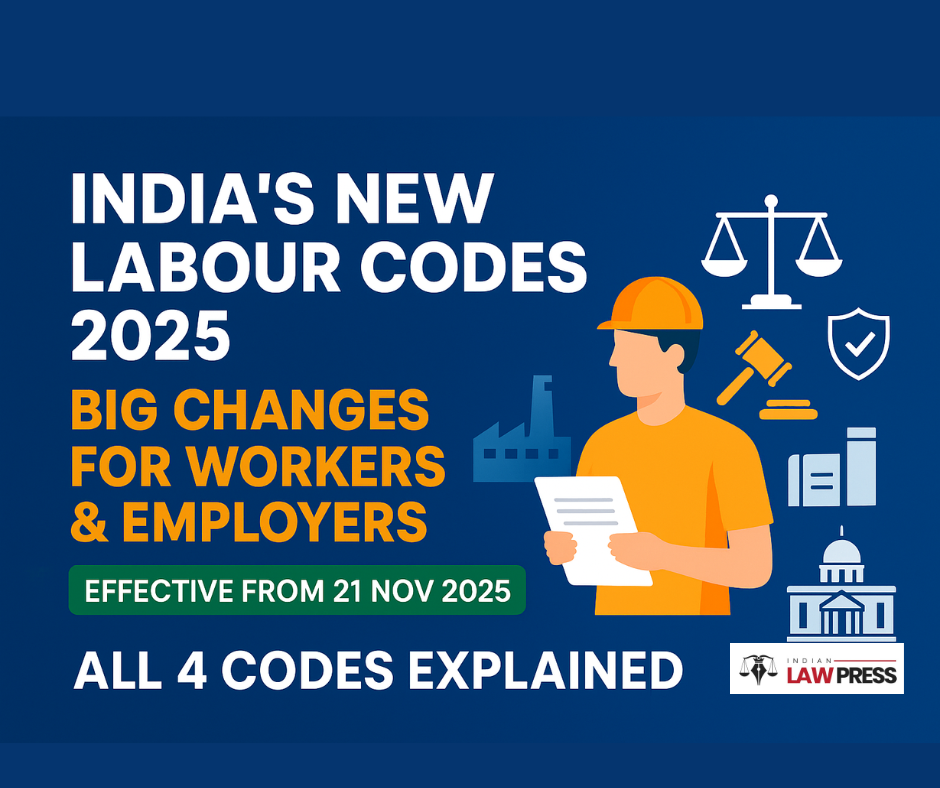
In a landmark move to modernise India’s labour regulatory framework, the Government of India has announced that all four Labour Codes will come into force from 21 November 2025.
The four codes include:
- Code on Wages, 2019
- Industrial Relations Code, 2020
- Code on Social Security, 2020
- Occupational Safety, Health and Working Conditions (OSH) Code, 2020
This reform replaces 29 existing Central labour laws, marking one of the most significant overhauls in India’s labour law system. The government has described it as a step toward a modern, transparent, and efficient labour ecosystem.
Why the Labour Codes Were Introduced
Many of India’s earlier labour laws were enacted during the pre- and post-independence era. Over time, they became complex, fragmented, and outdated, creating compliance challenges for employers and uncertainty for workers.
The new Labour Codes aim to:
- Simplify compliance procedures
- Reduce legal ambiguity
- Expand worker protection
- Ensure uniformity across industries
- Promote ease of doing business
Importantly, the Codes extend benefits to gig workers, platform workers, contract labourers, migrant workers, women employees, and MSMEs, bringing previously unregulated sectors under formal protection.
Major Reforms Under the Labour Codes
-
Universal Minimum Wages
The Code on Wages guarantees minimum wages for all workers across sectors and ensures timely wage payments.
-
Mandatory Appointment Letters
Employers are required to provide formal appointment letters, ensuring transparency and reducing informal employment.
-
Expanded Social Security Coverage
The Code on Social Security expands ESIC coverage nationwide. Even establishments with one hazardous-process worker are covered, and fixed-term employees become eligible for benefits like PF, insurance, and gratuity.
-
Health and Safety Improvements
The OSH Code introduces several worker-friendly provisions:
- Free annual health check-ups for workers above 40
- Gender-neutral wage provisions
- Women allowed to work night shifts with safety measures
- Stricter norms for hazardous industries
- Mandatory safety committees
-
Social Security for Gig Workers
For the first time, gig and platform workers will receive social security benefits, funded partly by aggregator platforms.
-
Simplified Compliance System
The Codes introduce a unified system with:
- Single registration
- Single licence
- Single return filing
The inspector-cum-facilitator model promotes guidance over penalties, helping businesses comply more effectively.
-
Faster Dispute Resolution
Specialised industrial tribunals with defined timelines aim to ensure:
- Speedy dispute resolution
- Transparent proceedings
- Predictable outcomes
Sector-Specific Improvements
The Labour Codes introduce targeted reforms across industries:
- Double wages for overtime work
- Enhanced safety standards in mines and hazardous sectors
- Protection for workers in IT/ITES, ports, textiles, and export units
- Special welfare measures for beedi and cigar workers
Transition and Implementation
During the transition phase, existing labour laws will remain in force until the new rules under the Labour Codes are finalised.
This phased implementation ensures clarity, stability, and smooth adoption across industries and states.
Impact on India’s Workforce
The government highlighted that social security coverage in India has increased from 19% in 2015 to over 64% in 2025.
The Labour Codes are expected to:
- Expand worker protection
- Improve benefit portability
- Strengthen labour welfare
- Create a more productive and secure workforce
Overall, the reforms aim to align India’s labour laws with global standards while supporting the vision of Aatmanirbhar Bharat.
Conclusion
The implementation of the four Labour Codes marks a transformative shift in India’s labour law regime. By simplifying regulations and expanding worker protections, the reforms aim to strike a balance between economic growth and social justice.
If implemented effectively, these changes have the potential to create a modern, inclusive, and future-ready workforce in India.
Top 10 Career Options After LLB in 2026: Best Opportunities for Law Graduates