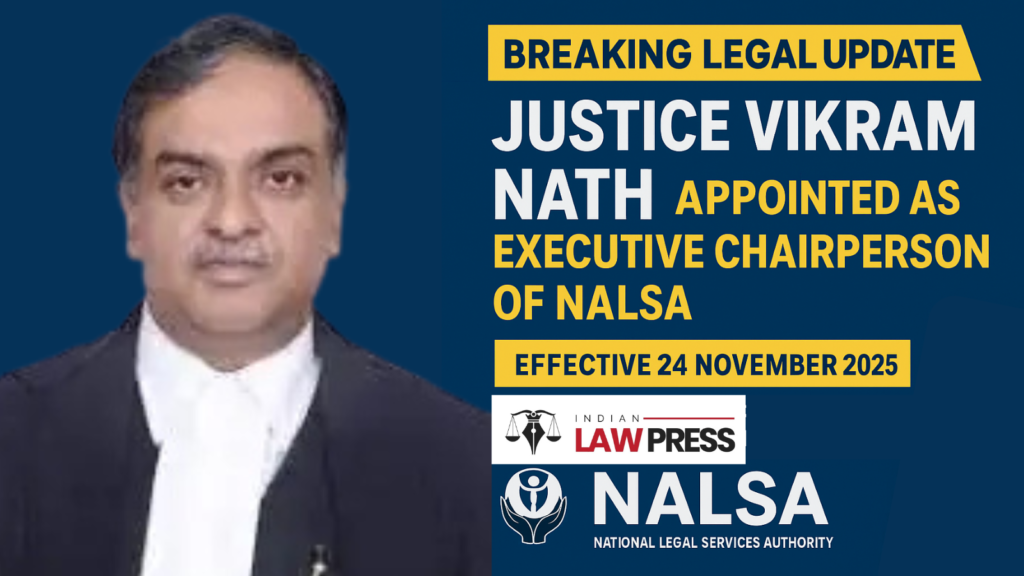

Justice Vikram Nath Appointed NALSA Executive Chairperson
Justice Vikram Nath has been appointed as the Executive Chairperson of NALSA effective November 24, 2025. Learn about NALSA’s structure, functions, and importance in providing legal aid.
Introduction
The President of India has appointed Justice Vikram Nath, senior judge of the Supreme Court of India, as the new Executive Chairperson of the National Legal Services Authority (NALSA).
The appointment will take effect from November 24, 2025, under Section 3(2)(b) of the Legal Services Authorities Act, 1987.
This move is in line with established judicial convention, where the position is typically assigned to the second senior-most judge of the Supreme Court.
What is NALSA?
The National Legal Services Authority (NALSA) is the apex statutory body responsible for ensuring free and competent legal services to economically weaker and disadvantaged sections of society.
It operates under the Legal Services Authorities Act, 1987 and fulfills the constitutional mandate of Article 39A, which guarantees equal access to justice.
Key Objectives of NALSA
NALSA works to:
- Provide free legal aid to vulnerable and marginalised groups
- Promote legal awareness and literacy
- Organise Lok Adalats for quick dispute resolution
- Implement victim compensation schemes
- Facilitate access to courts through legal aid clinics
Structure of NALSA
NALSA functions through a multi-tier structure to ensure nationwide reach:
National Level
- Patron-in-Chief: Chief Justice of India
- Executive Chairperson: Second senior-most Supreme Court judge
- Responsible for policy-making and oversight
State Level (SLSAs)
- Chaired by Chief Justices of High Courts
- Coordinate legal aid services at state level
District and Taluk Levels
- District Legal Services Authorities (DLSAs)
- Taluk Legal Services Committees (TLSCs)
- Provide direct legal assistance through lawyers and volunteers
This decentralised framework ensures access to justice at the grassroots level.
Major Schemes and Initiatives
Legal Aid Clinics
- Provide free legal advice in rural and underserved areas
- Operate in villages, jails, and institutions
Lok Adalats
- National and Mega Lok Adalats
- Permanent Lok Adalats under Section 22-B
- Help reduce pendency and promote amicable settlements
Victim Compensation Schemes
- Implemented under Section 357A CrPC
- Support victims of crimes such as acid attacks and trafficking
Para-Legal Volunteers (PLVs)
- Assist citizens in understanding legal rights
- Help connect individuals with legal aid services
Targeted Social Campaigns
- Support for women, senior citizens, migrant workers, and prisoners
- Special focus on transgender persons and persons with disabilities
Role of Executive Chairperson
As Executive Chairperson, Justice Vikram Nath will:
- Oversee nationwide legal aid programmes
- Monitor implementation of NALSA schemes
- Coordinate with SLSAs and DLSAs
- Strengthen legal aid delivery systems
- Promote digital legal services
- Supervise Lok Adalat functioning
His leadership will be crucial in expanding access to justice across India.
Key Highlights
- Justice Vikram Nath appointed NALSA Executive Chairperson
- Effective from November 24, 2025
- Appointment under Legal Services Authorities Act, 1987
- Focus on strengthening legal aid framework
- Enhancing access to justice for vulnerable groups
Conclusion
The appointment of Justice Vikram Nath as Executive Chairperson marks an important step in reinforcing India’s legal aid system.
With his experience and leadership, NALSA is expected to further strengthen its outreach, efficiency, and impact in delivering justice to all sections of society.
This development reflects the judiciary’s ongoing commitment to making justice accessible, inclusive, and effective.